
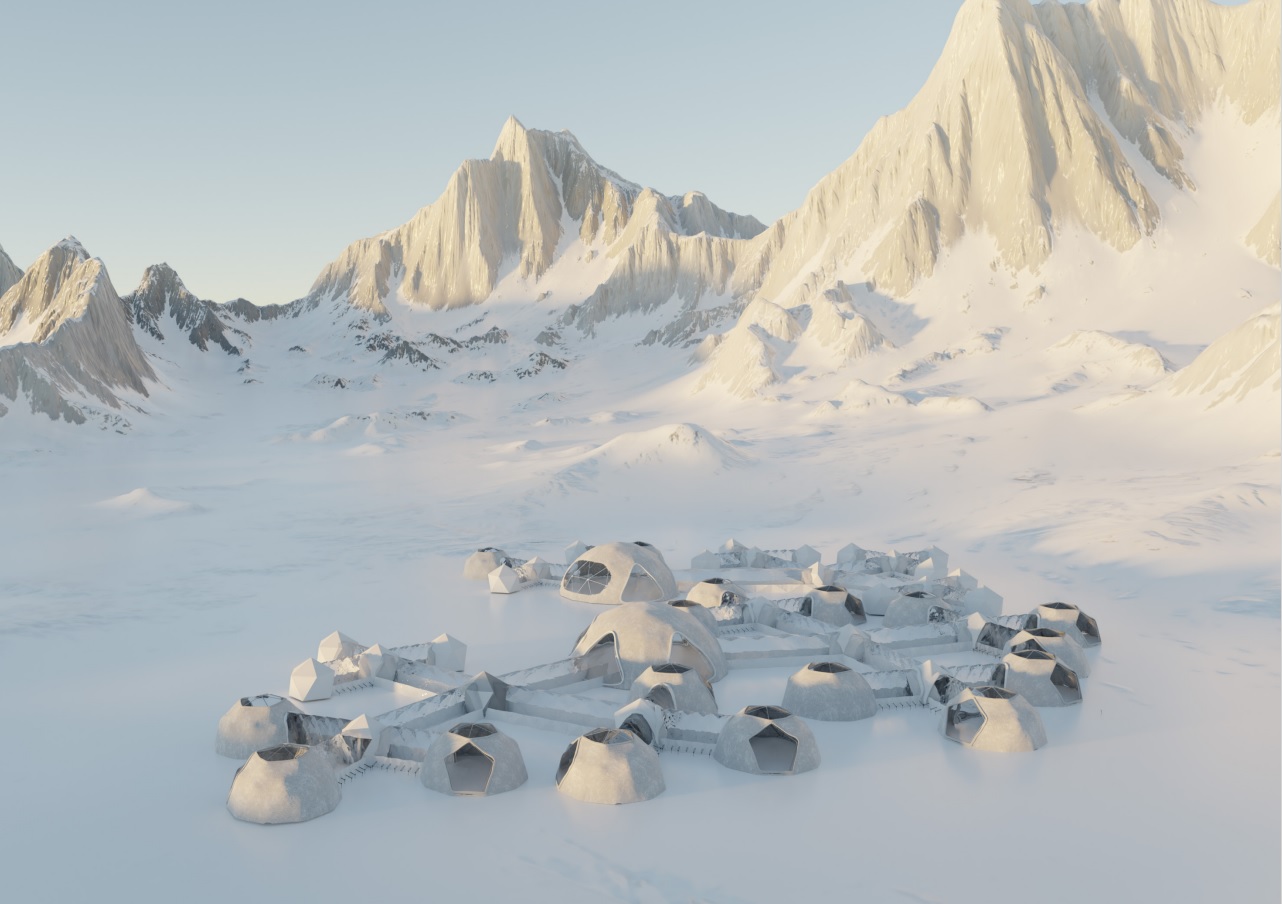
This solution designed by ELISAVA in collaboration with The NeverRest Project for a comprehensive system of modular tents that can be linked to shared service spaces, such as rest areas, kitchens, and dining rooms in the Everest Base Camp.
MAKURA is a system designed by Irene Morera from Elisava Barcelona School of Design and Engineering in collaboration with The NeverRest Project to redesigning Everest Base Camp’s currently deployed geodesic domes to incorporate a connector module for interconnecting accommodation units. It comprises a comprehensive system of modular tents that can be linked to shared service spaces, such as rest areas,kitchens, and dining rooms. Including these connector modules significantly enhances the quality of life and safety, particularly during adverse weather conditions.

Allowing tents to be interconnected during challenging weather, such as heavy storms, eliminates the need to venture outside to reach another tent. This, in turn, reduces the risk of tents flying away due to strong winds and improves heat retention, which is the primary threat in this extreme environment.
Value proposal
A connector module is designed to link geodesic domes while ensuring effective heat retention, thermal comfort for occupants, and enhancing the Everest Base Camp’s overall quality of life, safety and equality. These modules are designed to be sturdy and aerodynamic, capable of withstanding powerful wind gusts of up to 160 km/h.
Additionally, the interchangeable and universally compatible parts and components among the tents simplify repairs and reduce the overall transportation weight. This not only benefits the environment by minimizing the need for various parts but also promotes resource efficiency. Moreover, it reduces the manufacturing of small batches, which is both environmentally and economically wasteful.

The concept of cohabitation primarily focuses on the communal dynamics of a group of individuals and the architectural typology that facilitates these dynamics. In the social context, it aims to enhance the quality of life by striking a balance between individuals’ autonomy and privacy while encouraging mutual support and shared community services. In the realm of architecture, cohabitation typically involves buildings with a higher proportion of shared spaces and services than what is typically found in conventional structures.

Cohabitat embodies several values: collaboration, community, sustainability, accessibility and innovation. It fosters the creation of shared spaces, encourages community interaction and commitment, and promotes a culture of mutual respect and support. In many contexts, sharing common areas and services can be a challenge.
However, there are many benefits to doing so:
Savings
Sharing the utilization of services and communal spaces within a cohabitation setting can substantially reduce space expenses for operators, resulting in potential cost savings and an enhancement in their overall quality of life.
Communication
Participating in a community-based cohabitation arrangement entails the sharing of common spaces, fostering open communication and collaboration among local mountain guides, staff and international climbers. This dynamic encourages individuals to jointly shoulder responsibilities and collectively address challenges.

Equality
A shared community creates an environment where individuals are less likely to feel disadvantaged or excluded. This, in turn, encourages a coexistence where residents can focus on building positive relationships, collaborating on responsibilities, and addressing any issues that may arise collectively.
In a shared community setting, every residentis provided with equal access to the samearray of services and shared spaces. This commitment to equal access not onlyenhances the overall living experience but also plays a pivotal role in mitigating conflicts and preventing potential resentments thatmay arise among cohabitants.
Life quality
Using shared spaces and services in the Base Camp can substantially enhance the quality of life for its cohabiting residents. This arrangement allows both local workers and international visitors the opportunity to access and enjoy facilities that may be financially difficult if acquired individually.
Responsability
Sharing spaces and services within a community entails a collective responsibility. Residents learn to not only take care of their individual spaces but also to collectively steward the common areas and services in which they all participate.