Individual responsibility requires responsible governance
We cannot ask millions of visitors to change their behaviour while the structures managing destinations continue to operate as they did twenty years ago. Sustainability must also transform how destinations are governed.
For years, much of the environmental conversation has been built around a difficult idea to dispute: each of us must take responsibility for our own impact.
Do not leave waste behind. Stay on designated trails. Reduce emissions. Avoid sensitive areas. Consume fewer resources. Compensate where necessary. Understand that entering a natural environment also means accepting a responsibility towards it.
All of that makes sense.
But perhaps it is time to complete the sentence.
Individual responsibility requires responsible governance.
We cannot ask millions of visitors to change their behaviour while the structures managing destinations continue to operate largely as they did twenty years ago.
Sustainability cannot simply mean educating tourists. It must also mean transforming the way governments, destination managers, businesses and tourism operators manage the impacts generated by tourism itself.
If we ask more, we must provide the tools
When someone visits a national park, a marine reserve or any other protected natural area, their presence inevitably creates pressure on the territory.
They travel. They consume water and energy. They generate waste. They use infrastructure. They produce emissions. And they share space with ecosystems that, in many cases, are already under significant environmental pressure.
We can ask them to be aware of that.
We can even ask them to contribute financially to conservation.
But if we do, we must provide something in return: information, transparency and a genuine ability to act.
If we want visitors to reduce their impact, we first need to be able to explain what that impact is.
If we want them to contribute financially, we need to explain where their money goes.
And if we expect them to change certain behaviours, we need to provide viable alternatives that allow them to do so.
Otherwise, we are transferring responsibility to individuals that the management system itself has not yet fully assumed.
Measure before asking
There is another fundamental issue: we cannot manage what we do not understand.
What pressure does tourism actually place on a specific ecosystem?
How much water does it consume?
How much waste does it generate?
Where are the main pressure points?
Which activities create the greatest environmental impact?
At what times of the year?
In which areas?
And which conservation projects should be prioritised as a result of that information?
Too often, we discuss sustainability through broad, aggregated indicators, while conservation happens in precisely the opposite way: in specific places, facing specific problems, requiring specific solutions.
A national park does not only need to know how many people visited last year. It needs to understand what happened within the territory as a consequence of those visits.
That is where data-driven environmental governance begins.
Tourists cannot be the only ones under scrutiny
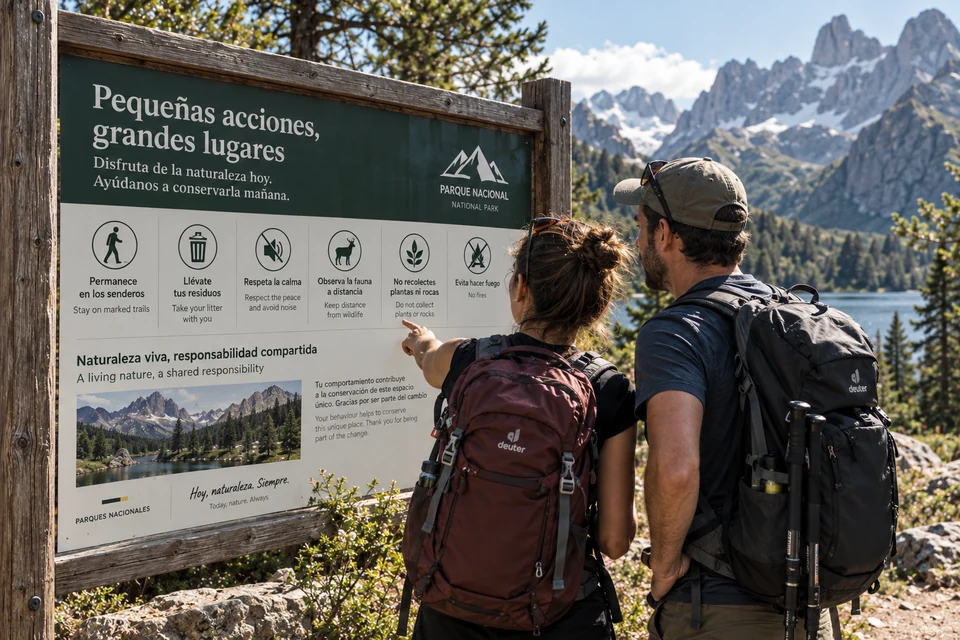
It is relatively easy to put up a sign saying, “Protect this place.”
Building the system capable of actually protecting it is considerably more difficult.
It requires technology, measurement, maintenance, infrastructure, institutional coordination, funding, transparency and continuous monitoring.
At that point, responsibility is no longer exclusively individual.
Public authorities must create frameworks that make action possible. Protected-area managers need better tools to understand tourism pressure. Companies that derive economic value from these territories should participate in the solutions. And technology should enable millions of individual interactions to become useful information for conservation.
Responsibility must extend across the entire value chain.
Visitors, operators, businesses, destination managers and public institutions.
Because placing responsibility solely on the final link in that chain may be convenient. It is also clearly insufficient.
From awareness to participation
For decades, we have tried to make visitors more environmentally aware.
Perhaps the next step is to enable them to participate.
There is an important difference between telling someone, “Take care of this park,” and being able to explain:
This is the approximate impact associated with your visit. These are the main environmental challenges facing this territory. These are the projects working to address them. And this is how you can contribute.
At that point, we stop treating tourists simply as part of the problem and begin integrating them into the solution.
But to do that, we need something that has historically been missing from many environmental policies related to tourism: traceability.
If there is a financial contribution linked to conservation, visitors should be able to understand how much is collected, how much reaches the territory, which projects are funded and what results those projects achieve.
Transparency should not be a polished section buried somewhere in an annual sustainability report.
It should be built into the system itself.
The private sector has responsibilities too
Governance does not end with public institutions.
Hotels, tour operators, booking platforms, transport companies, guides, concessionaires and businesses whose economic activity depends on natural destinations are all part of the same tourism ecosystem.
And if economic value is generated because these territories exist and remain attractive, it is reasonable to expect participation in their conservation as well.
That does not necessarily mean more taxes or more bureaucracy.
There are potentially more effective mechanisms: shared technology, project financing, integrated measurement systems, contributions linked to tourism activity, or tools that allow visitors themselves to participate directly.
Public-private collaboration can turn conservation into part of a destination’s economic infrastructure rather than treating it merely as another budget line competing for funding every year.
A new contract between visitors and territory
We are entering a period in which natural destinations will have to manage something far more complex than visitor numbers.
They will have to manage impact.
And that requires changing some of the questions we ask.
Not only how many people entered, but what pressure their presence generated.
Not only how much money they spent, but how much value remained within the territory.
Not only what behaviour we expect from visitors, but what tools we provide them with.
And, above all, not only how much responsibility we are prepared to demand from tourists.
But how much responsibility we are prepared to demand from ourselves as managers, businesses and institutions.
Individual responsibility is essential.
But it only works when there is a responsible system behind it.
Protecting natural environments cannot depend exclusively on millions of individuals independently choosing to do the right thing.
We need to make doing the right thing the easiest, most transparent and most logical option.
And that is no longer just the visitor’s responsibility.
It is a matter of governance.
Frederic Kauffmann, CEO, The NeverRest Project.
Let's work together
Want this measured in your territory?
We help park authorities, destinations and technology partners measure tourism pressure and act on it with data.
Contact us →