Counting visitors is not enough: we need to show what improved because they came
Visitor numbers, occupancy and spending describe activity, not outcomes. Why destinations need traceability, territorial intelligence and a third question: what improved because they came?
For decades, tourism has measured success using a familiar combination of indicators: visitor numbers, year-on-year growth, occupancy rates and visitor spending.
These figures matter. The problem begins when we confuse them with outcomes.
A destination can welcome more tourists, increase revenue and celebrate another record-breaking year while water stress, waste generation, ecosystem degradation or resident dissatisfaction continue to rise. In that scenario, tourism has grown. The territory has not necessarily improved.
This is why the emerging shift in the international conversation matters. The World Travel & Tourism Council is calling for destination stewardship to sit at the heart of tourism policy and for destinations to move beyond visitor volume. Its framework incorporates resident satisfaction, better data, spatial and seasonal distribution, and the reinvestment of tourism revenue into local communities.
It is an important change. But it leaves one decisive question unanswered: what exactly does “creating value” for a place mean?
The problem with good intentions
Words such as sustainability, regeneration and positive impact are appearing more frequently in destination strategies, institutional presentations and tourism plans.
Using more sophisticated language, however, does not automatically produce a more sophisticated management model. A destination does not become regenerative because it replaces “promotion” with “stewardship” in its strategy.
The difference emerges when it can demonstrate results.
If we talk about reinvesting tourism revenue, we should know how much is collected, how it is distributed, who decides where it goes and what outcomes it produces.
If we introduce a visitor contribution, we should be able to trace it to the environmental or community intervention it funds.
If we claim that tourism benefits local people, we should measure how those benefits are distributed.
Without traceability, positive impact is difficult to distinguish from good intentions. And it is difficult to regenerate a place with a PowerPoint full of arrivals and overnight stays.
Measuring activity is not the same as measuring transformation
Tourism generates enormous amounts of data. We know where visitors come from, how long they stay, where they sleep, how much they spend and which places they visit.
Yet we still struggle to answer more relevant territorial questions: What pressure does each type of visit place on water, waste systems or biodiversity? How much of the economic value generated remains in the territory? What contributions does tourism make to conservation? Which projects receive those contributions? What environmental or community indicators improve as a result?
This distinction matters. Tourism data describes activity. Territorial, or place-based, intelligence should help us make decisions and demonstrate results.
Destination British Columbia offers an interesting example. Its climate resilience programme has created a shared data framework and now allows results to be compared across two reporting years. More than 305 tourism businesses participated in the second round, while the proportion making climate adaptation investments increased from 64% to 72%.
That is a valuable baseline. The next step is to connect those business actions to territorial outcomes. Which risks were reduced? Which communities became more resilient? Which ecosystems are now better prepared? Which investment produced which result?
Knowing how many businesses took action is important. Knowing what became more resilient because they acted is even more useful.
When visitor contribution stops being abstract
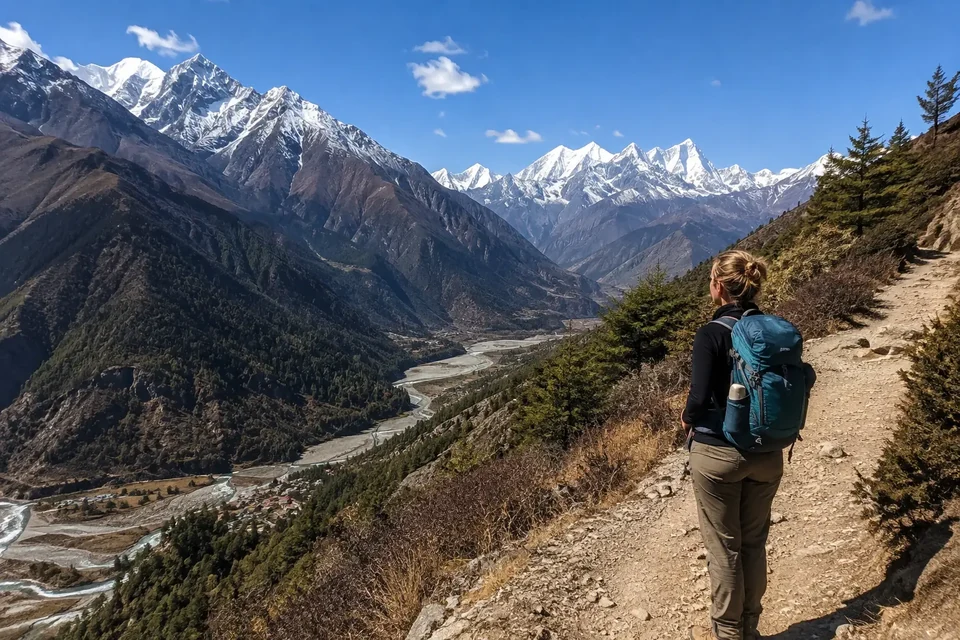
In Nepal’s Khumbu Valley, on the route to Everest, we can find a simple but revealing example.
The Carry Me Back programme, developed by Sagarmatha Next and the Sagarmatha Pollution Control Committee, allows visitors to carry one-kilogram bags of processed waste from Namche Bazaar to the Lukla airstrip. From there, the materials continue their journey to recycling facilities.
More than 35,000 people have helped remove around 45 tonnes of waste.
Here, visitor participation is not limited to a generic invitation to “travel responsibly”. There is a specific action, a measurable unit of contribution and a quantifiable result.
The model could go further by showing the final destination of each waste stream, the costs covered, the materials recovered and the value generated for local communities. But it already contains a powerful idea: turning the visitor from a passive consumer into an active participant in a territorial solution.
That comes much closer to regeneration than an awareness campaign with no measurable outcome.
From individual action to collective impact
Regenerative tourism is not only about reducing harm. It is about building a verifiable chain between the visitor’s presence and the improvement of the place.
I would describe that chain as: individual impact → data → territorial intelligence → traceability → redistribution of value → education → collective impact.
A visitor takes an action or makes a contribution. That interaction generates data. The data helps us understand the needs and pressures affecting the territory. Traceability shows where the contribution ends up. Redistribution directs value towards conservation, public services or community initiatives. Communicating the result educates the visitor and encourages future participation.
Technology can help build this infrastructure, but technology is not the objective. A QR code, an app or a data dashboard does not generate regeneration on its own. Its role should be to connect decisions, resources and results in a way that is both understandable and verifiable.
The question is not how much technology a destination uses. The question is whether that technology helps manage the territory better and strengthens trust.
A tourist tax is not automatically conservation finance
The same principle should apply to tourist taxes, voluntary contributions and visitor-giving mechanisms.
Collecting money from visitors does not automatically turn a financial instrument into regenerative or conservation finance. For a genuine contribution to exist, we need to follow the money and demonstrate what improved because of it.
What proportion returns to the territory experiencing the pressure? Who selects the projects? Do local communities participate in the decision? Are the results published? Can visitors see the impact of their contribution?
Traceability is not a minor technical detail. It is the foundation of the mechanism’s legitimacy.
It also closes the educational loop. When visitors understand that their contribution helped restore a habitat, manage waste, protect a water source or support a community organisation, they stop seeing it as just another tourism charge. They begin to see it as part of their relationship with the place.
The question destinations should start asking
I am not suggesting that we abandon economic indicators. Tourism still needs to understand demand, occupancy, spending and employment. I am suggesting that we stop treating them as a complete definition of success.
Alongside “How many people visited?” and “How much did they spend?”, destinations should introduce a third question: what improved because they came?
Answering it requires data, economic mechanisms, traceability and a willingness to publish results. It also forces us to acknowledge when impact does not exist or when the value generated fails to reach the people and ecosystems carrying the burden of tourism.
That exercise may be uncomfortable. That is precisely why it is useful.
A destination is not regenerative because its visitors have good intentions. It becomes regenerative when it can organise those intentions, turn them into meaningful contributions and demonstrate that they produce collective improvement.
The future of destination management will not depend only on our ability to attract people. It will depend on our ability to turn every visit into territorial value and to show, clearly and credibly, where that value went.
Frederic Kauffmann, CEO, The NeverRest Project.
Let's work together
Want this measured in your territory?
We help park authorities, destinations and technology partners measure tourism pressure and act on it with data.
Contact us →