From AI that sells destinations to intelligence that governs them
Tourism is discovering the potential of artificial intelligence to attract visitors. Its real revolution may lie in learning how to manage the destinations those visitors come to experience.
Artificial intelligence has entered the tourism industry at remarkable speed. Today, it can design personalised itineraries, recommend experiences, anticipate preferences, optimise pricing and produce marketing campaigns in seconds. Never before have we had so many tools to convince someone to visit a destination.
But there is a question worth asking: Are we using artificial intelligence to manage destinations more effectively, or simply to bring more people to them?
The distinction is fundamental.
For decades, the tourism industry has perfected its promotion, marketing and distribution mechanisms. We have learned how to identify markets, segment audiences and convert interest into bookings. Now, with artificial intelligence, we can do all of this faster, more precisely and on an extraordinary scale.
Yet our ability to understand what actually happens within destinations has not necessarily evolved at the same pace.
A destination may know the exact cost of acquiring a visitor while having little understanding of the environmental cost associated with that person's stay. It may accurately forecast hotel occupancy for the coming weeks while lacking sufficient information about the pressure those visitors will place on water resources, biodiversity or local infrastructure.
We know increasingly more about how to get tourists to arrive. We still know far too little about what happens once they are there.
From commercial intelligence to territorial intelligence
The real opportunity for artificial intelligence in tourism is not simply to improve the visitor experience. It is to expand our ability to understand, anticipate and manage the consequences of tourism activity.
And that requires asking different questions.
Instead of focusing exclusively on how many visitors we expect to receive, we should be able to anticipate where they will concentrate, which resources they will require, what pressure they will place on ecosystems and how the economic benefits of their presence can be distributed more effectively.
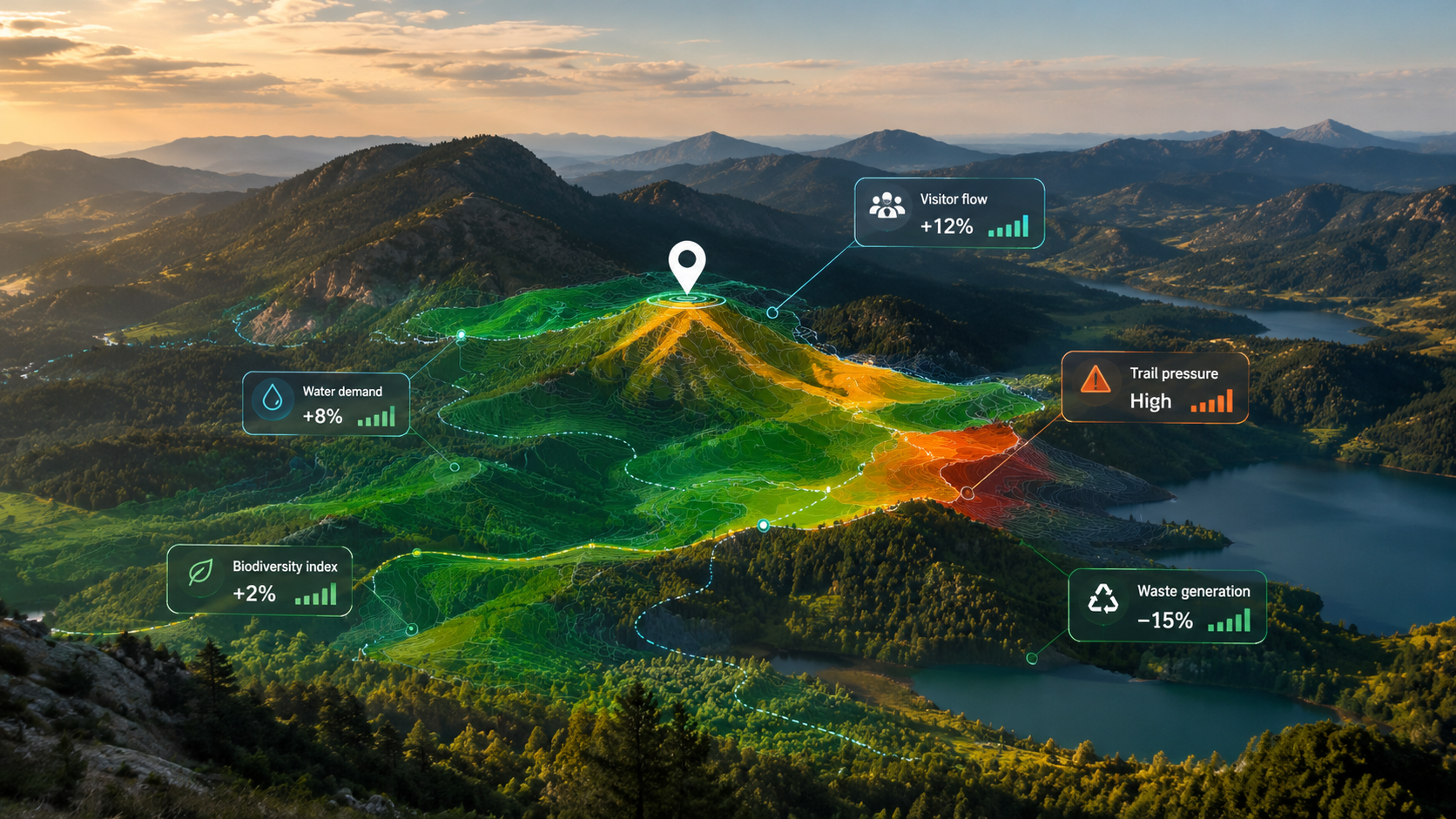
Imagine a national park receiving thousands of visitors every day. Its managers know how many entrance tickets have been sold, but that figure alone tells only a fraction of the story.
How much waste is generated? Which trails experience the greatest pressure? How does water consumption fluctuate? Which areas require preventive intervention? What proportion of tourism revenue actually returns to conservation?
Combining environmental data, tourism information, predictive models and artificial intelligence could help answer these questions and, more importantly, enable action.
This is not about accumulating information in sophisticated dashboards. It is about transforming data into operational decisions.
Because a dashboard that nobody uses to make decisions is ultimately a rather elegant way of decorating a lack of management.
Technology is advancing. Governance must keep up.
This transformation is already emerging on international agendas.
The OECD's Tourism Trends and Policies 2024 highlights the importance of strengthening tourism data systems and developing more effective indicators to support sustainable destination management. It also emphasises the need for better coordination across government and stronger evidence-based policymaking.
The direction is significant. Tourism innovation must increasingly move beyond commercial efficiency towards the capacity to manage complex territorial systems.
However, introducing artificial intelligence does not automatically improve governance.
An algorithm can identify concentrations of visitors, but it cannot independently determine the appropriate balance between economic activity and environmental protection. It can detect consumption patterns, but it cannot legitimately decide how public resources should be distributed. It can recommend interventions, but the responsibility for implementing them remains with the relevant institutions and organisations.
Artificial intelligence should strengthen human decision-making, not replace it.
Achieving this requires shared objectives, reliable data, transparency and effective public-private collaboration.
Tourism data needs to connect with environmental data
One of today's greatest challenges is information fragmentation.
Tour operators understand bookings and customer movements. Public administrations collect visitor statistics. Environmental organisations gather information about biodiversity, waste, water and conservation. Local communities understand how their territories are changing.
But these different sources of knowledge are rarely connected systematically.
The result is an incomplete picture of the destination.
Artificial intelligence can help integrate these sources, identify relationships and build models capable of interpreting tourism activity from economic, social and environmental perspectives.
Consider, for example, an anticipated increase in visitors to a protected natural area.
A territorial intelligence system could combine visitor forecasts, weather conditions, water availability, habitat sensitivity and local service capacity to recommend preventive measures before problems arise.
Naturally, such models would require validation, human oversight and sufficiently representative data. But they could fundamentally transform our ability to anticipate challenges.
We would move from managing the consequences of tourism to managing the conditions that produce them.
And that shift has economic, environmental and social value that is difficult to ignore.
From tourists as consumers to tourists as participants
There is another dimension that I find particularly interesting.
Until now, the digital relationship with tourists has been built primarily around transactions: search, book, pay, visit and review.
But what if we extended that relationship towards participation?
Visitors can also become a source of valuable information and active contributors to conservation, provided that the interaction is responsible, transparent and respectful of their privacy.
Their participation could help identify environmental incidents, report problems along trails, support restoration initiatives, record positive actions or contribute financially to conservation priorities defined by the destination itself.
This would create a much richer relationship between tourism, communities and ecosystems.
Furthermore, the information collected, properly anonymised and validated, could improve our understanding of the destination and support future decisions.
The objective is not to turn every visitor into a permanent sensor or transfer institutional responsibilities onto tourists. It is to provide genuine opportunities for people to contribute to the protection of the places they enjoy.
Regenerative tourism requires precisely this evolution: moving beyond an experience focused exclusively on consumption towards a relationship in which visiting a destination can also generate value for that territory.
Measuring success differently
Artificial intelligence can optimise almost any indicator we ask it to. And this raises another essential question: what do we choose to measure?
If we continue evaluating tourism success primarily through visitor growth, overnight stays and revenue, we will be using extraordinarily advanced technologies to pursue essentially the same objectives we have followed for decades.
The technology will be new. The underlying logic will remain unchanged.
We need indicators that help us understand what benefits actually remain within a destination.
Knowing how much revenue tourism generates is not enough. We should also understand how much is reinvested in conservation, how ecosystem conditions evolve, what economic opportunities reach local communities and whether we are reducing the environmental costs associated with tourism activity.
Most importantly, we need to establish meaningful relationships between the decisions we make and the results we achieve.
The OECD has already highlighted the need to strengthen the evidence base for sustainable tourism through indicators that reflect environmental and social priorities, while ensuring policymakers have access to timely information.
This perspective invites us to reconsider the very concept of tourism profitability.
A destination that increases revenue while progressively degrading the natural resources on which it depends may be reporting strong short-term economic results while undermining its long-term viability.
Territorial intelligence should help identify these contradictions before their consequences become irreversible.
Artificial intelligence does not need to govern. We need to govern intelligently.
There is an important distinction to make.
Applying intelligence to tourism governance does not mean delegating the future of destinations to algorithms.
It means developing better tools to support more informed, transparent and responsible decisions.
Intelligent systems can also introduce bias, reproduce inequalities and concentrate control over information in the hands of those with the greatest technological resources.
That is why technological development must be accompanied by clear principles concerning data ownership and access, community participation, institutional oversight and impact assessment.
Public-private collaboration will be essential, but it must be built around shared territorial objectives and measurable responsibilities.
We do not need technology platforms to replace institutions. We need institutions capable of using technology to act with greater knowledge, agility and effectiveness.
And we also need a private sector willing to contribute information, expertise and resources to the management of the destinations from which it benefits.
The next competitive advantage of a destination
For a long time, tourism competitiveness has been associated with the ability to attract visitors.
In the coming years, that ability will remain important, but it will probably no longer be sufficient.
Destinations will increasingly need to demonstrate that they can manage tourism activity effectively, protect their natural assets, anticipate risks and distribute benefits more equitably.
Artificial intelligence can become a decisive tool in achieving this transformation.
Not because it has all the answers, but because it can help us ask better questions, identify problems earlier and evaluate the consequences of our decisions more accurately.
The real breakthrough will not come when artificial intelligence can recommend the perfect destination to every traveller.
It will come when destinations can understand, in time to act, what is happening within their territories and use that knowledge to protect their ecosystems and improve the lives of the people who call them home.
We have spent decades developing intelligence to attract tourists. Perhaps it is time to invest the same ambition in caring for the places they come to experience.
Because the future of tourism will depend not only on our ability to sell destinations, but on our intelligence to preserve what makes them worth visiting.
Frederic Kauffmann, CEO, The NeverRest Project.
Let's work together
Want this measured in your territory?
We help park authorities, destinations and technology partners measure tourism pressure and act on it with data.
Contact us →