
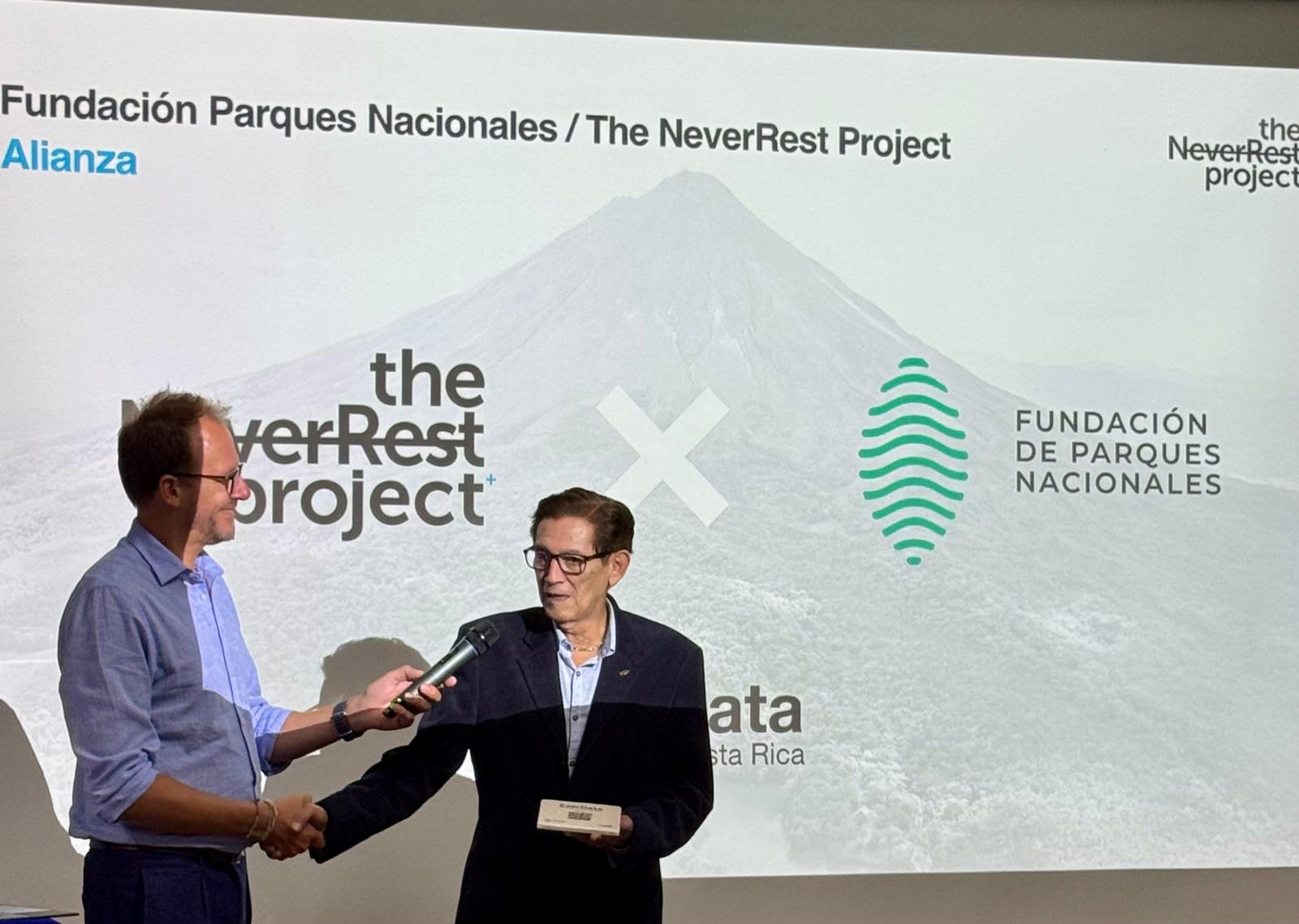
The Costa Rica National Parks Foundation (FPN) and The NeverRest Project have signed a collaboration agreement to measure the environmental impact of tourism at the inauguration of the Expo Ambiente 2025 event in San José.
San José, August 22, 2025. Costa Rica’s national parks will measure the impact of tourism in order to maintain environmental balance with the technology of the environmental innovation corporation The NeverRest Project. This was announced yesterday by the president of the Costa Rica National Parks Foundation (FPN), Ricardo Meneses-Orellana, accompanied by the CEO and founder of The NeverRest Project, Frédéric Kauffmann, during the inauguration of the Expo Ambiente congress being held this week in San José.
At the opening ceremony of the event, representatives from the Costa Rica National Parks Foundation (FPN) and The NeverRest Project signed the collaboration agreement through which Costa Rica’s national parks will take another step in their demonstrated global leadership in sustainable and regenerative tourism, to continue “conserving, educating, and protecting” their ecosystems while also “generating tangible benefits for our local communities, by opening opportunities for income redistribution and job creation”, in the words of Ricardo Meneses-Orellana.

Frédéric Kauffmann and Ricardo Meneses-Orellana, after signing the collaboration agreement to measure the environmental impact in Costa Rica’s national parks.
The CEO and founder of The NeverRest Project, Frédéric Kauffmann, celebrated this agreement with Costa Rica, “a pioneer country in environmental policies that now goes one step further, because it knows the importance of data and metrics. Costa Rica has decided to incorporate the EverData portal, which allows us to see where we are and where the country’s tourism is headed. Because it is no longer about how many tourists come, but how they are going to come. The tourist who contributes positively to the country should be welcomed with a red carpet, and the one who doesn’t must be understood as a source of problems. It makes no sense that the income a country receives from tourism then has to be spent on cleaning instead of on improvements for the population and ecosystems.”
The president of the Costa Rica National Parks Foundation (FPN) also emphasized the need to design public policies based on “strengthening environmental transparency, meeting the United Nations Sustainable Development Goals, and above all, ensuring that each visitor to our protected areas leaves a positive footprint and not a burden on our parks.” Meneses-Orellana stressed that this international alliance places Costa Rica once again “as a global leader in conservation and tourism, proving that we are a small country in territory, but immense in commitment, tourism vision, and climate change as a reality. We cannot talk about the future of tourism without talking about sustainability. We cannot talk about climate change without recognizing the role of tourism and its research as both an opportunity and the responsibility of being a living laboratory,” highlighting that “having accurate data is not a luxury, but a necessity.” All of this, with “the goal of building a tourism that does not merely admire nature, but also protects and regenerates it.”
The agreement involves collaboration between both entities in implementing advanced technological systems for the measurement, monitoring, and precise optimization of environmental impacts derived from tourism and other activities in Costa Rica’s protected wilderness areas.
The technology of The NeverRest Project provides a specialized digital platform that makes transparent the environmental footprint of tourism, allowing it to be transformed into redistributive and regenerative economic mechanisms that directly benefit local populations. The system facilitates the collection, visualization, and analysis of field data—such as mapping, real-time monitoring, and project management tools—to help stakeholders understand and mitigate environmental impacts.
EverData arrives in Costa Rica: Visitors to its national parks increase by 33% in just 10 years
The pioneering EverData Costa Rica platform is now publicly available, incorporating the first data on the impact of tourism on Costa Rica’s ecosystems. Cross-referenced tourism and environmental indicators can now be found in one place, such as the number of visitors that national parks have received in recent years, which parks have received the most visits, how much waste each visitor generates, as well as their CO2 emissions, among many other valuable data points.
Among the data provided by EverData, it is possible to analyze, for example, how the number of tourists visiting the country’s national parks has increased by 33% in just ten years, which makes it necessary to design new strategies to control the impact of tourism in order to protect their ecosystems.
The EverData platform is designed to aggregate, analyze, and visualize official, accurate, and transparent data on environmental, tourism, and social parameters. It provides practical information and forecasting capabilities, facilitating evidence-based decision-making while reinforcing principles of legal compliance, objectivity, and public interest in the frameworks for ecological restoration and regenerative management.
About the Costa Rican National Parks Foundation (FPN)
The Costa Rica National Parks Foundation (FPN) is a long-standing, private, non-profit organization founded in 1979, dedicated to the protection, management, and comprehensive promotion of Costa Rica’s national parks and protected wilderness areas.
Throughout its history, FPN has directly contributed to the acquisition and consolidation of more than 90,000 hectares for national parks, supported the establishment and operation of volunteer programs, and pioneered a wide range of community projects and environmental education initiatives.
About The NeverRest Project
The NeverRest Project is an environmental innovation technology corporation that works to find balance between tourism, the environment, and local communities, scaling its experience on Everest into solutions for the implementation of regenerative tourism in other parts of the world.
One of The NeverRest Project’s pioneering solutions is EverData, a platform where for the first time essential data is collected, analyzed, and visualized on environmental impact, waste management, and tourism activity in the Everest region, in addition to conducting analyses and forecasts of tourism and environmental evolution for the next five years.
Previously, it also developed the first proposal for a Sustainable Base Camp on Everest, among other solutions and campaigns launched from the summit of Everest to raise awareness about the need for more balanced tourism that benefits both travelers and local communities and their ecosystems.
With the support and collaboration of Ferrino, Garmin, Eurecat, and Elisava School of Design and Engineering of Barcelona.